
Richmond County Civil Docket Searches
The first online stop for Richmond County Superior and State Court records is the official Augusta Case Management Search. Its agreement opens a second search host. That host does not always load. An empty result or a failed page is not proof that no civil docket exists. Note the landing page warning too: online data is not certified for authenticity or accuracy. Gather the exact party name, court, and case number from a notice or filed paper. Then use each available channel.
- Identify whether the matter belongs to Superior, State, Civil, Magistrate, Probate, or a municipal court.
- Try the official case-management landing page for a Superior or State matter and allow its new window.
- Use the full case number as printed. Richmond County has not published a civil code pattern that should be guessed.
- If the web route fails, call or visit the clerk that keeps that court's civil docket.
- For a copy, give the clerk party names, the case number, filing type, and date range.
Georgia keeps no single statewide portal. Nothing there replaces Richmond County clerks. The Georgia Courts E-Access directory only routes users to providers. Mail can work where an office supplies a request form. Augusta Open Records is not the court-file channel.
Richmond Civil Cases Need the Right Clerk
Hattie Sullivan is Clerk of Superior, State & Juvenile Court. That office holds Superior Court civil and domestic records plus State Court files. It sits at 735 James Brown Boulevard, Suite 1500. Civil and domestic callers should choose option 5 at 706-821-2460. A search at another office may come up empty. You may simply have asked the wrong custodian.
DeLisa Johnson's Civil and Magistrate Court office keeps its own lower-court dockets in Suite 1400. Call 706-821-2370 during public hours, Monday through Friday, 8:30 a.m. to 5 p.m. Probate files use Suite 1000 and 706-821-2434.
Civil and Magistrate Court
735 James Brown Boulevard, Suite 1400
Augusta, GA 30901
706-821-2370
Monday through Friday, 8:30 a.m. to 5 p.m.
Note: Give the clerk a court name as well as a party name, since several offices hold Richmond County civil records.
Civil Dockets: What They Show
A civil docket normally tracks the case header, assigned court and judge, party roles, dated filings, settings, rulings, and disposition. Treat those fields as a request checklist. The court does not promise every item appears online. Ask the clerk for whatever the screen lacks.
| Case number and filed date | The clerk's identifier and the date the complaint or petition entered the docket. |
|---|---|
| Parties and roles | The caption and plaintiff, defendant, petitioner, or respondent labels. |
| Pleadings and service | The opening paper, service entries, answer, and later pleadings. |
| Motions and orders | Requests made to the judge and signed rulings entered in response. |
| Settings and judgment | Hearing notices, trial settings, judgment, enforcement, or appeal entries. |
A line on the Richmond County civil docket is an index to an event. It is not always the document itself. A motion entry may require account access or a clerk copy request, and certification comes only from the custodian.
Richmond Civil and Magistrate Limits
The official court summary draws a key local line. Richmond County Civil Court hears disputes up to $45,000. Magistrate Court hears disputes not over $15,000. Superior Court keeps broad civil power, with exclusive subjects like title, equity, and divorce, while Probate runs its own estate and guardianship docket.
| Court | Role | Starting point |
|---|---|---|
| Superior | Major civil and exclusive subjects | Case-management page or Suite 1500 |
| Civil | Disputes up to $45,000 | Suite 1400 |
| Magistrate | Disputes not over $15,000 | Suite 1400 |
| Probate | Estates and guardianships | Suite 1000 |
These amounts define jurisdiction, not copy prices. The official jurisdiction source shows the Richmond County Civil and Magistrate distinction.
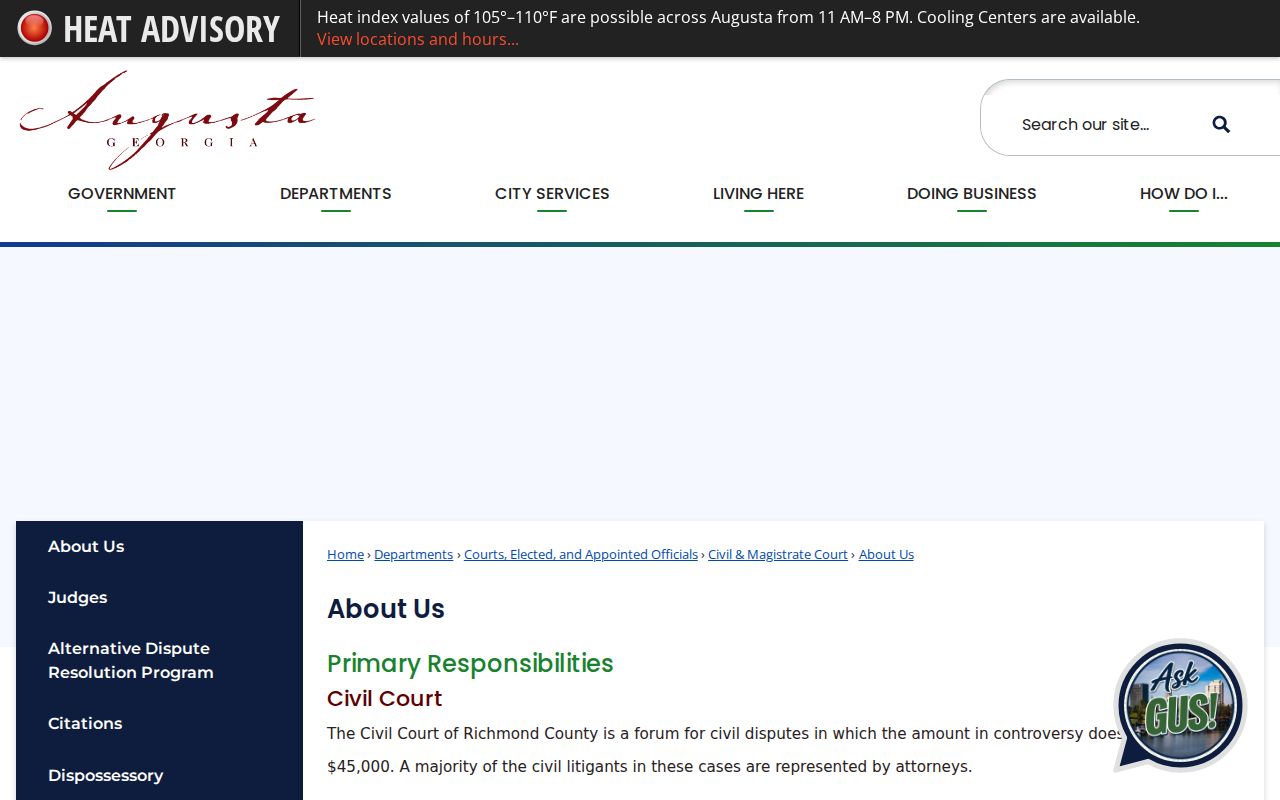
The official page helps route a Richmond County civil docket search before any record request begins.
What Cases Fill the Civil Docket
Civil cases in Richmond County ask the court for noncriminal relief, and the dockets reflect that range. The clerk's Civil and Magistrate forms index lists the kinds of local filings that show up, including:
- small-claims summonses and answers;
- dispossessory pleadings and writs of possession;
- wage and financial-institution garnishment;
- civil complaints within the court's limit; and
- post-judgment notices and enforcement papers.
Superior civil dockets reach further, covering domestic matters and other major civil disputes. Probate is different. Even though an estate file has nothing to do with crime, it moves through the Probate Court, not a generic civil docket result.
PeachCourt and Richmond Civil Filings
Richmond County's e-filing notice makes PeachCourt mandatory for Superior and State Court civil and domestic filings. The screen asks for an email and password. Options let you register or recover a lost login. It serves filers and account users.
That login is not a public guest docket. PeachCourt is the filing and account route, nothing more. Anyone who cannot use it should turn to county case management or contact the proper clerk. For lower-court matters, the office source shows the fallback path at Civil and Magistrate Court.
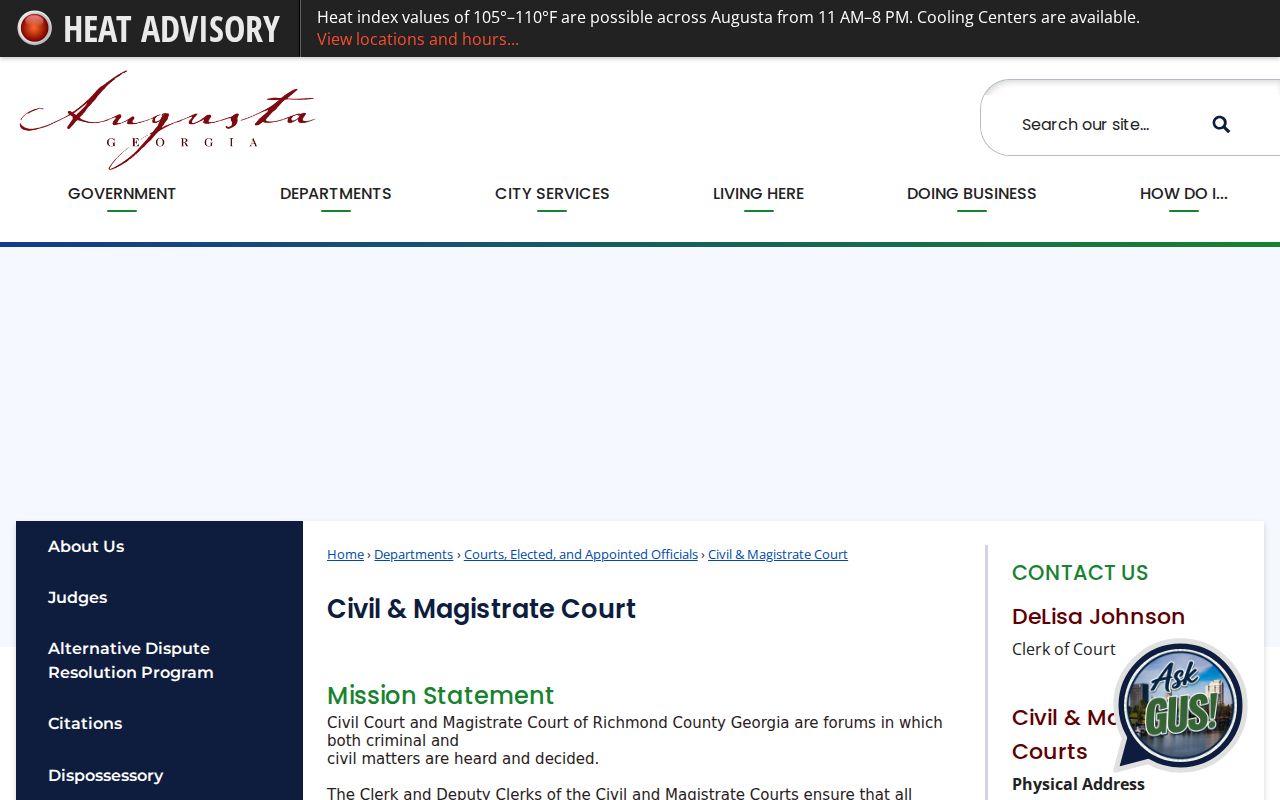
When no web account opens a Richmond County civil docket, the clerk's office is the place to go.
Hearings on the Civil Docket
The local civil path runs complaint or petition, service, answer, discovery and motions. Next comes the setting, then trial or a dispositive ruling. After judgment, enforcement or appeal may follow. A setting may be a status conference, motion hearing, or trial. The event label matters as much as the date. Read the notice for date, time, place, judge, and purpose. Confirm it with the responsible Richmond County clerk. A continuance is a court-approved move; a reset is the new date entered later. A request alone does not move the hearing. The Richmond County court schedule gives more help with local settings.
Richmond Civil Filing Fees Differ
The official fee schedule lists filing and service costs, not a copy chart. A Civil complaint without service costs $35, and a Magistrate filing without service costs $48. Marshal service may add charges by defendant count. Dispossessory and garnishment carry separate lines.
Filing fees are not copy fees. Ask the Richmond County clerk for the current price of a plain copy, certified copy, or other certification.
Name each document and ask for a quote before sending funds. That keeps the cost to open a case from being mistaken for the cost to inspect its docket.
Richmond Civil Dockets After Judgment
A Richmond County civil docket does not always go quiet once judgment enters. The case flow often keeps moving. Writs, garnishment, enforcement steps, and appeals can each leave later entries, filed under a new date. The judgment line records the court's formal decision, but collection or review may follow afterward.
So when you track a resolved Richmond County dispute, ask for everything after the judgment date, not just the judgment. A post-judgment writ is one thing to look for. Wage or bank garnishment is another. Watch also for a satisfaction, a notice of appeal, or a transfer. The clerk can tell you what the public docket shows and which paper needs to be ordered. A closed status alone does not prove that no enforcement record exists. Keep your request narrow. Need proof a debt was paid? Ask whether a satisfaction was filed. Tracking review of the ruling? Ask for the notice of appeal and any transfer entry. Working to understand enforcement? Request the writ or garnishment entry by its filed date.
Spell out full terms when you read the file. Richmond County publishes no verified local abbreviation sheet, so do not treat national shorthand as a local docket code. Each line in the Richmond County civil docket is a distinct part, and the document behind it may hold more detail than the online index shows.
Who Can See Civil Dockets
Richmond County Superior Court records are generally open under Uniform Superior Court Rule 21 unless law or an order limits access. Open access does not put every document online.
Key access rules:
The Georgia Open Records Act governs many public records, but Augusta routes court files to the court clerk.
Juvenile records have stronger limits under O.C.G.A. §15-11-708. Sealed child and family material may not appear.
Some details stay hidden even in an open court record. Account numbers and Social Security numbers may be redacted. So may birth dates, minor names, and protected judicial information. A restricted civil docket can return no result. It may show a shell entry or a case file missing its protected documents. Ask the clerk about the route. An open-records request cannot override a sealing order or force the creation of a report.
A later docket entry does not always change the judgment. Some entries simply carry it out. An appeal asks a higher court to review the ruling. The Court of Appeals of Georgia handles most intermediate appeals. The Richmond County clerk can point out the local notice and transmit record entries. Once review begins, the appellate docket stands alone.